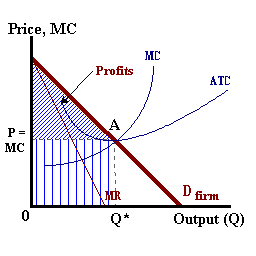
 The picture above represents the long run equilibirum of a monopolistically competitive firm. The short run profits induce entry into the industy. The increased entry has two effects. The first is the business stealing effect. New companies, with new differentiated products, capture some of the market of the existing firms. At the same time, the existence of more substitutes due to entry, causes the demand curve for the individual firm to be more elastic (D to D' and MR to MR'). In the long run, the industry settles at a point where there are zero economic profits for all the firms (at q lower than the min of ATC).
Wednesday, November 15, 2006
LR Equilibrium in Monopolistic Competition
The picture above represents the long run equilibirum of a monopolistically competitive firm. The short run profits induce entry into the industy. The increased entry has two effects. The first is the business stealing effect. New companies, with new differentiated products, capture some of the market of the existing firms. At the same time, the existence of more substitutes due to entry, causes the demand curve for the individual firm to be more elastic (D to D' and MR to MR'). In the long run, the industry settles at a point where there are zero economic profits for all the firms (at q lower than the min of ATC).
Tuesday, November 14, 2006
Demand Elasticity and Total Revenue

Note: Please ignore the minus sign in front of the elasticity numbers. This post refers to the the link between Total Revenue (TR) and the elastic part of the demand curve.
As shown in the figure, the elasticity in the upper part of the demand curve, between the horizontal intercept and the midpoint of the demand line is the area where the elasticity is less than -1 (or greater than +1). At the midpoint the elasticity is = 1, and this is where TR is maximized (i.e. where MR=0).
To the right of the midpoint, on the lower part of the demand curve, elasticity is greater than -1 (or less than +1). In this area TR is falling as the price falls.Firms should never willingly operate in the inelastic part of their demand curves. By producing less they can increase revenues so, by definition, profits would be higher. Firms will not operate where we have unit elasticity unless there are no costs of production.
Comments on PS 4
Hey guys, here are a couple of comments on PS4
a. With regards to extra credit, the range of credit is 1 to 3, one being given for legitimate effort and 3 given for a correct answer.
b. For question 1, please note that machinery is NOT a cost. Read the solutions carefully and let me know if you have further questions on this one.
c. Your graphs need to be more precise! Do not forget to label the axis and/or the curves! This is important! There is no reason to lose points on the hourlies for such things!
Also, a request from the grader: Please staple your problem sets before handing then in and your writing needs to be legible!
Sunday, November 12, 2006
Battle of the Sexes, Where do they go?
 The Battle of the Sexes is a two player game used in game theory. Imagine a couple, Kelly and Chris. Kelly would most of all like to go to the football game. Chris would like to go to the opera. Both would prefer to go to the same place rather than different ones. If they cannot communicate where should they go?
The the payoff matrix labeled "Battle of the sexes (1)" is an example of Battle of the Sexes, where Chris chooses a row and Kelly chooses a column.
This representation does not account for the additional harm that might come from going to different locations and going to the wrong one. In order to account for this, the game is sometimes represented as in "Battle of the sexes (2)".
How do we find the Nash Equilibrium in this case? Is there more than one?
Classic Prisoner's Dilemma and Pop Culture
Game Theory and Pop Culture: http://gametheory.net/popular/
The classical prisoner's dilemma (PD)* is as follows:
The classical prisoner's dilemma (PD)* is as follows:
Two suspects A, B are arrested by the police. The police have insufficient evidence for a conviction, and having separated both prisoners, visit each of them and offer the same deal: if one testifies for the prosecution against the other and the other remains silent, the silent accomplice receives the full 10-year sentence and the betrayer goes free. If both stay silent, the police can only give both prisoners 6 months for a minor charge. If both betray each other, they receive a 2-year sentence each.
It can be summarized thus:
| | Prisoner A Stays Silent | Prisoner A Betrays |
| Prisoner B Stays Silent | Both serve six months | Prisoner B serves ten years; Prisoner A goes free |
| Prisoner B Betrays | Prisoner A serves ten years; Prisoner B goes free | Both serve two years |
The dilemma arises when one assumes both prisoners are selfish enough to want to minimize their own jail term. Each prisoner has two options: to cooperate with his accomplice and stay quiet, or to betray his accomplice and give evidence. The outcome of each choice depends on the choice of the accomplice. However, neither prisoner knows the choice of his accomplice. Even if they were able to talk to each other, neither could be sure that they could trust the other.
Let's assume the protagonist prisoner is rationally working out his best move. If his partner stays quiet, his best move is to betray as he then walks free instead of receiving the minor sentence. If his partner betrays, his best move is still to betray, as by doing it he receives a relatively lesser sentence than staying silent. At the same time, the other prisoner thinking rationally would also have arrived at the same conclusion and therefore will betray.
It would be rational then for a prisoner to decide to cooperate if only he could be sure that the other player would not betray, and thus achieve a better result than in mutual betrayal. However, such a cooperation is then rationally vulnerable to the treachery of selfish individuals, which we assumed our prisoners to be. Therein lies the paradox of the game.
If reasoned from the perspective of the optimal interest of the group (of two prisoners), the correct outcome would be for both prisoners to cooperate with each other, as this would reduce the total jail time served by the group to one year total. Any other decision would be worse for the two prisoners considered together. However by each following their individual interests, the two prisoners each receive a lengthy sentence, which in fact hurts both the interest of the group and that of the individuals.
*Source: Wikipedia, www.wikipedia.comWednesday, November 08, 2006
Oligopoly Watch
A great blog on Oligopolies: http://www.oligopolywatch.com/
(Note: we will be covering oligopolies in class, on Monday of next week)
(Note: we will be covering oligopolies in class, on Monday of next week)
What is a Natrual Monopoly?
A comprehensive review in Wikipedia: http://en.wikipedia.org/wiki/Natural_monopoly
Tuesday, November 07, 2006
PS4 Solutions and PS5
Hey everybody,
The solutions to PS4 have been posted on the Ec10 Website.
Also PS5 has been posted as well. It is due on Friday, Nov 17th in Section.
Please note, I will hold my regular office hours on Wednesday, 7-8:30pom in Room 112, Littauer.
The solutions to PS4 have been posted on the Ec10 Website.
Also PS5 has been posted as well. It is due on Friday, Nov 17th in Section.
Please note, I will hold my regular office hours on Wednesday, 7-8:30pom in Room 112, Littauer.
Tuesday, October 31, 2006
Profit Maximization for a Competitive Firm
http://www.whitenova.com/thinkEconomics/profit.html
Hey guys, here's another nice applet to use for your understanding of profit maximization by a competitive firm.
Again, here, if you scroll down you will find the section of the "Interactive Graph". There you can see the usual cost curves of a firm, i.e. the Marginal Cost (MC), the Average (Total) Cost (ATC) and the Average Variable Cost (AVC).
First you select any price on the Y-axis. This is the price that is prevalent in the market. Remember, the firm is a price taker, therefore at the prevailing market price, it's demand curve is a horizontal line. Next, once you choose the price, you are asked to choose the profit maximizing quantity. Where are the profits maximized according to what we said in class? What is the universal profit maximizing condition?
Once you find the correct profit maximizing quantity, click on it. If your answer is correct, the applet will tell you so. Then, a couple of colored rectangles will appear, and if you scroll over them, the relevant areas on the graph will be highlighted.
The areas are:
TR = Total Revenue
TC = Total Cost
Greek Capital Pi = Profit (or Loss)
TVC = Total Variable Cost
TFC = Total Fixed Cost
You can perform the same analysis for different prices too! Let me know if you have any questions!
Monday, October 30, 2006
Firms Long Run Average Cost Curve
Hey guys, as promised, here's the link to the website that talks about the actual construction of a Long Run Average Cost Curve:
http://www.whitenova.com/thinkEconomics/lrac.html
The first couple of paragraphs is a nice recap of what we talked about in class. When you scroll down, you will see a paragraph titled "Interactive Graph". SRATC stands for Short Run Average Total Cost whereas the K's refer to different levels of capital. In this case, you may think of the K's as more factories. To use the applet you have to:
Start by clicking on Q1. The applet will give you two points on the two short run cost curves. You have to chose which one is the most efficient. In other words, suppose that the market dictated that you have to produce Q1: would it make sense for you to build that next factory or not? Thus, once you click on Q1, the applet gives you your cost choices and you chose the graph that corresponds to the right factory (i.e. SRATC curve). If you do that for all quantities, Q1 to Q6 and you get the correct answer, the applet will show you have the LRAC curve is constructed.
Let me know if you have any questions on using this.Thanks.
Unit Test C
Unit Test C began on Sunday, Oct 29th and the deadline for our section is MONDAY, NOV 6th
You can find an updated Unit Test Schedule here
You can find an updated Unit Test Schedule here
Sunday, October 22, 2006

Friday, October 13, 2006
New Helpful Hint - Quotas
Please note that a new helpful hint has become available on the EC10 website and concerns Quotas! Make sure you have a look at it before the hourly!!
Thursday, October 12, 2006
1st Hourly Details
Change of exam location!
FOR BOTH MY 11AM AND 12PM SECTIONS: THE EXAM WILL TAKE PLACE AT 12PM IN Harvard 202!
Exam Coverage: All text readings up to and including Chapter 9 and all outside readings up to and including the ones for this week's problem set (#2).
Thus, Chapter 10 and Chapter 11 -- the topics of sections on this coming Friday and Monday will NOT be on this exam. They'll be tested on the next exam.
The official EC10 website now has "Practice Problems for First Hour Exam" section where you can find practice problems for the hourly.
For those of you that cannot attend my review section on Tuesday, 7:30-9:30pm, the Head Section Leader, David Johnson will give a coursewide review section on Tuesday 4:30-6pm, Room:TBA on the official EC10 website.
Wednesday, October 11, 2006
Production Subsidy

Production subsidy increases domestic production from B" to B' (because p* intersects with S + subsidy at B').
Production subsidy = rectangle ABB'A' = brown parallelogram.
Welfare loss = blue tablecloth triangle A'B'B".
Tariff: A Numerical example

Supply: p = 2 + y
Free Trade
Domestic Production. 5 = 2 + y, y = 3
Domestic Consumption 5 = 22 - x, x = 17
Import = 17 - 3 = 14.
CS = 17 × 17/2
PS = 3 × 3/2
TS = 149
Restricted Trade
Tariff: t = 5p = p* + t = 10.
Domestic Production: 10 = 2 + y. y = 8
Consumption: 10 = 22 - x, x = 12
M = x - y = 4.
CS = 12 × 12/2 = 72
PS = 8 × 8/2 = 32
GS = 5 × 4 = 20
TS = 124
Deadweight Loss = 25. (The sum of the two triangles)
An Export Subsidy

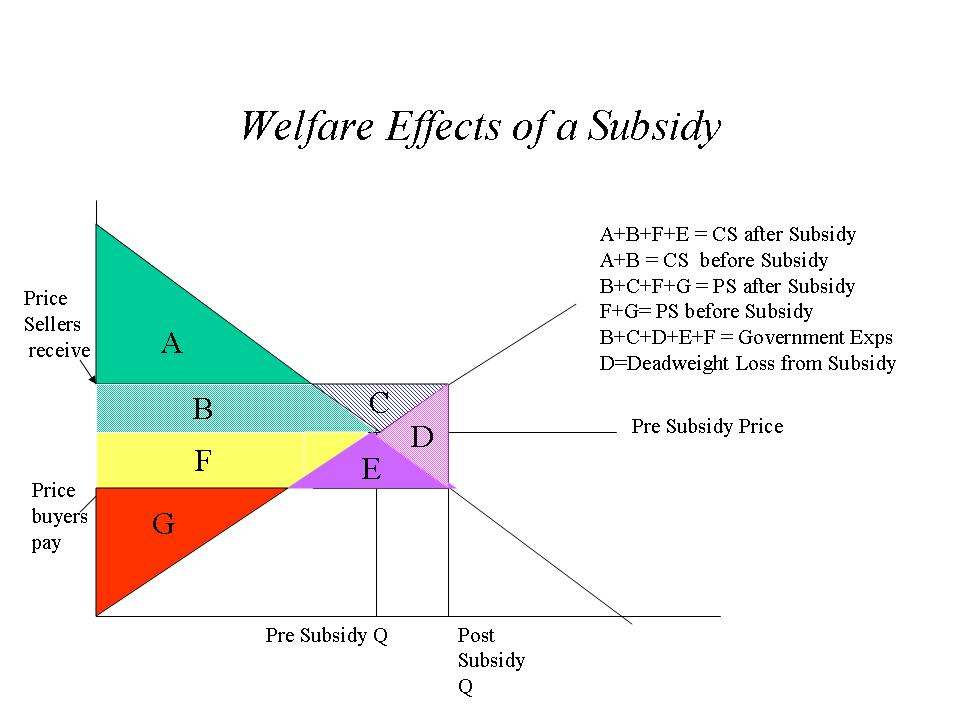
An export subsidy raises the domestic price above the world price by the amount of the subsidy because domestic firms would be unwilling to sell at home for less than they would receive if the product was exported. (see diagram)
As a result, consumers lose areas A and B.
Producer surplus rises by areas A+B+C+D+E.
The cost of the subsidy to the government equals areas B+C+D+E+F.
Overall, there is a net national loss (DWL) equal to areas B+F.


Tuesday, October 10, 2006
1st Hourly - Review Section
What? 1st Hourly Review Section
When? Tuesday, Oct 17th, 7:30pm-9:30pm
Where? Sever 103
When? Tuesday, Oct 17th, 7:30pm-9:30pm
Where? Sever 103
Monday, October 09, 2006
Reminders
a. Today (Monday!) is the last day to take the Unit Test. Note that it takes place in Science Center C!
b. Problem Set 2 has been posted already and is due on Friday, Oct 13th.
c. Problem Set 1 Solutions have been posted on the website. I will return your graded problem sets (PS1) by Monday the 16th at most (probably earlier) and I ll do my best to return PS 2 before the hourly.
d. The first hourly will take place on Oct 18th. An exam memo with all the necessary details, including material covered in the hourly will be available on the official EC10 website by the end of the week.
e. Note that the first three lectures by Prof Mankiw have been uploaded and are available for viewing (especially for those of you that might have missed any of them).
f. I will hold my regular office hours this week, on Wednesday, 7-8:30pm, in Room 112 in Littauer (first floor).
g. I have scheduled a review section for Tuesday, the 17th, 7:30-9:30 in Sever 103. If you cannot make it at this time, please drop me a line for alternative arrangements.
Wednesday, October 04, 2006
Unit Test Room Change
The Unit Test on Monday, October 9th will be held in Science Center C!
The original schedule said “TBA”, but a new version should be up on the web site shortly.
The original schedule said “TBA”, but a new version should be up on the web site shortly.
Subscribe to:
Posts (Atom)

